Roots & Heritage
A Heritage Tapestry
The Cochrane family ancestry weaves significant strands of Scandinavian, Scottish, Irish, and English history….
- Descended from Viking settlers who chose Scotland as their new homeland
- A family tradition of naval and military service spanning centuries
- Connected to the revolutionary evidence-based medicine
- Associated with statistical and mathematical advancement
- Connections with Clan Donald through numerous relationships
- A rich heraldic tradition emphasising valour, battle prowess, and maritime heritage
Heraldic Symbolism
- Clan Motto: "VirtutVirtuee et Labour" - "By valour and exertion"
- Heraldic Beast: The boar, with three boar's heads adorning the chief's shield, representing a warrior who killed three wild boars terrorising the countryside
- Clan Crest: A horse passant, Argent
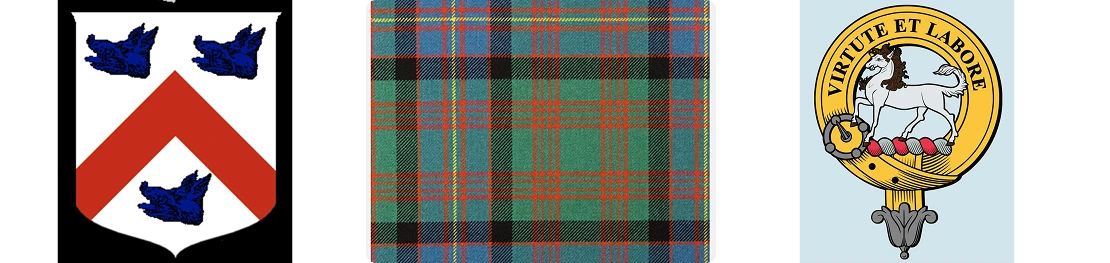
Primary Roots: The Cochrane clan traces its origins to a Scandinavian Viking warrior who settled in Renfrewshire between the eighth and tenth centuries. This Norse ancestor chose to establish roots in the Scottish Lowlands, specifically near Paisley.
Etymology and Meaning:
Cochrane: Believed to be a derivative of the Gaelic “The Roar of Battle” or “Battle Cry” Alternatives suggest: "coch ran" meaning "brave fellow" in Gaelic, attributed to an ancestor's bravery in battle, or links it to Old Welsh "coch" (red) and "ran" (brook)
Documentation: The first documented mention appears as Waldeve de Coveran, who served as a witness to a charter in 1262. The family evolved from the Norman name "Coveran" to the simplified Scottish "Cochran" and eventually "Cochrane."
Geography: Concentrated in Western Scotland (Renfrewshire and Ayrshire) at the heart of Scotland's medieval power struggles between Norse, Celtic, and emerging Scottish royal authorities - positioning Cochrane’s as key players in the formation of modern Scotland. From the mid-1800s, migration from Scotland to Ireland, Canada, and the US appears to have accelerated due to the Highland and Island clearances by the English in connection with the potato famine. Some also fled to Lancashire and the Midlands to work in cotton mills and coal mines.
Major Historical Figures
Admiral Lord Thomas Cochrane (1775-1860): The 10th Earl of Dundonald, was a British naval officer whose successes led Napoleon to nickname him "le Loup des Mers" (the Sea Wolf). Key achievements:
- Captured over 50 vessels in the Mediterranean while commanding HMS Speedy, including the Spanish frigate El Gamo with 2x the firepower and 6x as many men
- Helped create and organise the revolutionary navies of Chile and Brazil during their independence wars in the 1820s
- Buried at Westminster Abbey with an inscription praising his services to "Greece, Brazil, Chile and Peru”
- In modern times, he was the inspiration for the ‘Hornblower Novels’ and the movie Master and Commander
**Military Tradition: **Thomas Cochrane had brothers who served with distinction: William Erskine Cochrane (Major, 15th Dragoons) and Archibald Cochrane (Captain in the Navy)
**Math Legacy: **William Cochran (1909-1980): A prominent Scottish-born statistician who became influential in the USA, known for writing statistical classics & promoting statistics education represents the intellectual tradition associated with the family lineage.
**Medical Legacy: **Professor Archibald Leman Cochrane, CBE FRCP FFCM (1909 1988) was a British medical researcher who contributed greatly to the development of epidemiology.
The Cochrane Library now houses a primary collection of databases in medicine and healthcare specialities. Key to all this:
- His 1971 publication "Effectiveness and Efficiency" criticised the lack of reliable evidence in healthcare interventions
- A history of wider works led to The Cochrane Collaboration & Library in 1993, now the world's largest organisation for systematic medical reviews
MacDonald Clan Connections
**Sept: **The surname "Cochran" appears among the septs (affiliated families) of Clan Donald, specifically noted as "Only those from West Highlands & Islands". This suggests potential ancestral connections or allegiances between the Cochrane and MacDonald families.
Origins: Clan Donald traces its descent from Dòmhnall Mac Raghnuill (d. circa 1250), whose father, Reginald, was “King of the Isles” and whose grandfather, Somerled, was "King of the Hebrides". Somerled drove out the Vikings from the islands in 1156, establishing Celtic-Norse rule.
Viking Heritage: Both the Cochrane and MacDonald lineages share Norse-Gaelic origins
- DNA Testing shows a substantial proportion of MacDonald males share the same Y-haplotype R1a1, often indicating Norse descent
- This aligns with the Viking origins attributed to the Cochrane clan
Tartan: Features red, navy blue, black, and white, where red symbolises courage and loyalty, navy blue represents the sea (honouring naval connections), and black and white represent enduring strength and honour. The tartan sett is based on the old Lochaber district, also home to the MacDonald and Cameron families.
Clan Territories: Historical seats include Lochnell Castle Argyll, with associated castles including Auchindoun Castle, Johnstone Castle, and Dundonald Castle. The lands and estates centre on Paisley, Renfrewshire.
Leadership: The current chief is Iain Alexander Douglas Blair Cochrane, 15th Earl of Dundonald, 10th Baron Cochrane of Dundonald, and 10th Baron of Paisley and Ochiltree.

William Cochran (1909-1980)

Archibald Cochrane (1909–1988)

Admiral Lord Thomas Cochrane (1775-1860)